




Laura Hamilton lives in Northfield. She’s a Geology graduate and a volunteer with Lickey Geo-Champions. She’s recently discovered lots of fossils in Longbridge – around 160 million years old! Have a read, then pop down and see how many you can spot – send us your photos!

—
Laura writes:
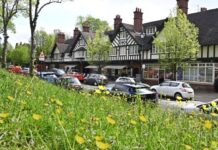
The Longbridge area of south Birmingham has great industrial history, with a large factory complex here once producing cars, as well as military related work during the war. This factory was hugely important to the history of Birmingham and the local history of this area. Following the collapse of the industry, the land was turned over to residential, community and retail use, and the new high street area has brought a new lease of life to this location. The shop fronts are faced with slabs of beautiful beige limestone, which is the subject of this blog.

I first noticed that these were fossiliferous (full of fossils) some time back in late 2015 and I think I’ve probably taken photos of every slab (that I can reach, anyway!). The main types of fossils that stand out are belemnite guards (long black bullets) and ammonites (round curly shapes). There are also some very nice fossil sponges, and all of the slabs contain detritus (fragmented and broken up pieces of shells). All of these fossils indicate that this is a marine rock – it formed under the ocean – and through lots of people on Twitter I have developed more of an understanding of this rock.

It is a limestone from the Jurassic period of geological time and was formed around 160 million years ago. The fossils show that this was a different environment to today, and the area in Germany where this rock is quarried was once a shallow sea (ammonites are generally thought of as the shallow water relation to nautiloids which prefer deeper water). Ammonites and belemnites are both part of the Cephalopod family. Only the hard parts of these animals are preserved – the soft body parts were either eaten (scavenged) or rotted away during the fossilisation process. The ammonite hard parts are the shell, which in this limestone are found in a range of orientations and show different aspects & views of the shells, and in a lot of cases you can clearly see the different chambers of the shell.

The belemnites are represented by the guards – long black bullet shapes which are thought to have acted as a counterweight for the rest of the animal. At the front end of the guard there is a feature called a phragmocone, which is divided into cells and is thought to have helped with buoyancy. This feature can be seen in some of the Longbridge fossils, but is generally rarely preserved – sometimes it just falls out, but most of the time it disintegrates as it is made of an unstable mineral (aragonite). The guard is made of calcite which is more stable and more likely to be preserved. Some of the fossils also have areas of calcite infill, which looks like white crystals.

I don’t know much about the sponges found in these rocks, so most of my pics are ammonites and belemnites!

The fossil slabs at Longbridge are very accessible – they surround the shop fronts along the high street and lots of the fossils are within human height! I tweeted a lot of photographs using the hashtag #LongbridgeFossils and there are also some on Instagram.

—
You can share your #LongbridgeFossils photos on our Facebook page or tweet us @B31Voices.
You can learn more about Lickey Geo-Champions via their web page or email lickeychampions@gmail.com Or follow @LickeyChampions on Twitter
Laura blogs at Adventures of a Laura and is @hammijam on Twitter
All photos copyright of Laura Hamilton
Most interesting Laura. Thank you for posting this. Up until now I have had no interest in visiting the new Longbridge town centre, but reading this and seeing your photos have just changed my mind.