



New research has revealed the staggering economic value of unpaid care in Birmingham, with families, friends and neighbours providing an estimated 139.4 million hours of unpaid care every year – equivalent to an estimated £3.28 billion.
Adjustable beds provider, Opera Beds, analysed unpaid caregiving data across 374 local authorities and found that 91,445 people are recorded as providing unpaid care in Birmingham, with 29,481 people providing 50+ hours of unpaid care every week.
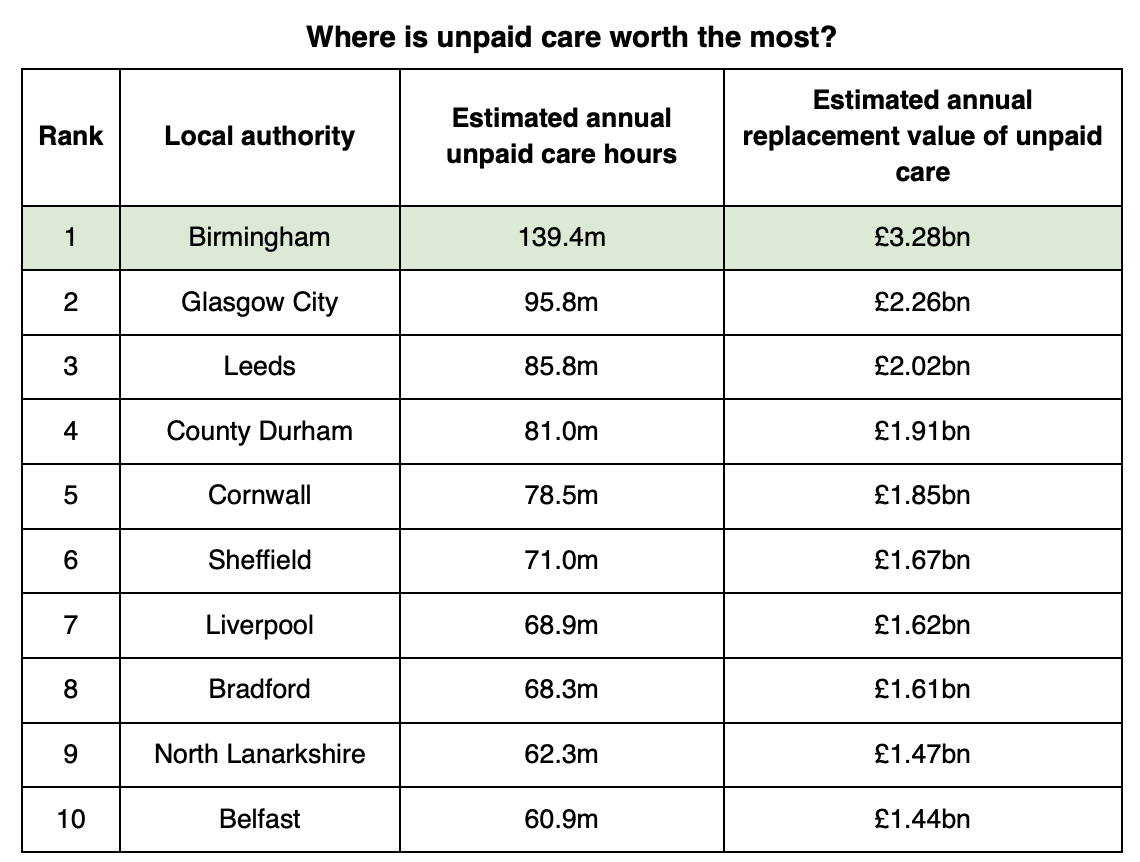
Birmingham records the highest estimated annual replacement value of unpaid care in the UK, with its 91,445 unpaid carers providing an estimated 139.4 million hours of care each year.
Replacing this care with paid home care would cost an estimated £3.28 billion.
Of these carers, 29,481 provide 50+ hours of care each week, equivalent to 2.76% of Birmingham’s residents. Overall, 8.55% of residents provide some form of unpaid care, highlighting the significant contribution carers make across families, households and communities.
Birmingham has also recognised the scale of its caring population, with its Carers Partnership Strategy setting out an ambition for the city to become a ‘Carer Friendly City’.
The findings suggest that while unpaid care plays a vital role in helping people remain supported at home, the contribution of informal carers can remain largely unseen, despite the enormous amount of time and economic value involved.
Further findings from the research include:
-
Unpaid carers provide an estimated 8.22 billion hours of care across the UK each year. Replacing those hours with paid home care would cost an estimated £193.6bn.
-
Approximately 5.84 million people are recorded as providing unpaid care, with approximately 1.73 million providing 50+ hours of unpaid care per week.
-
Inverclyde is the UK’s unpaid care hotspot, with 13.84% of residents providing unpaid care.
Barbara Franks, Occupational Therapist working with Opera Beds, said: “Providing 50 or more hours of unpaid care a week can affect almost every part of a person’s life. It can shape when they work, how they sleep, whether they have time for themselves, and how easily they can look after their own health.
“Many people taking on this level of care are supporting someone with changing mobility, frailty, dementia, recovery needs, or a long-term condition. That support can be deeply meaningful, but it can also become physically and emotionally demanding, especially if the person does not know what help may be available.
“When caring responsibilities start to increase, families should not wait until they are at crisis point to ask for advice. Speaking to a GP, asking for an assessment from the local authority, contacting carers’ organisations or an occupational therapist can help carers understand what support can help make day-to-day care more manageable.”
For more information on support available for carers in Birmingham, visit the Birmingham Carers’ Hub website: https://birminghamcarershub.org.uk
You can find the full research here: https://operabeds.com/blogs/
B31 Voices is run by volunteers and is committed to supporting communities across south west Birmingham and surrounding by keeping them informed and engaged. Follow us on Facebook, Twitter, Bluesky, Mastodon, Threads, Instagram, TikTok and YouTube. Support us by donating at www.b31.org.uk/donate. Send us local story ideas to hello@b31.org.uk